Edition
Edition 1: AI starts writing the immersive web
Our first edition arrives as AI begins to write the immersive web. Google’s Three-Live compiles AI-generated Three.js into glTF and USDZ and hands off to WebXR sessions; Meta’s Immersive Web SDK, now at 1.0 with gaze-and-pinch input, lets coding agents drive a test browser; and Google’s XR Blocks Gem turns a text description into a mixed reality scene. One hands-on review finds the agentic approach best suited to small prototypes for now. Beyond the tools, Valve switches on WebXR in a SteamOS beta for Steam Frame, NVIDIA streams GPU-rendered XR to the browser with CloudXR.js, and researchers build point clouds from WebXR depth data on a phone. For anyone starting out, a 12-step lab shows how a headset draws a view for each eye. We close with two announcements that stretch the word “immersive”: a Stanford video studio and an AR casino.
-
Lead WebXR3D on the Web
Introducing Three-Live: turning AI-generated Three.js into interactive 3D, AR, and WebXR across web and mobile
Google has released Three-Live, an Apache 2.0 developer preview library that compiles AI-generated Three.js code into glTF and USDZ files in a few milliseconds. On the web it runs scripts in a sandboxed Web Worker and offers an xr-live package for hand gestures, spatial interface elements and handoff into immersive WebXR sessions.
Original article at Google Open Source Blog -
WebXR-based mobile point cloud rendering and semantic segmentation using depth data and voxel fusion
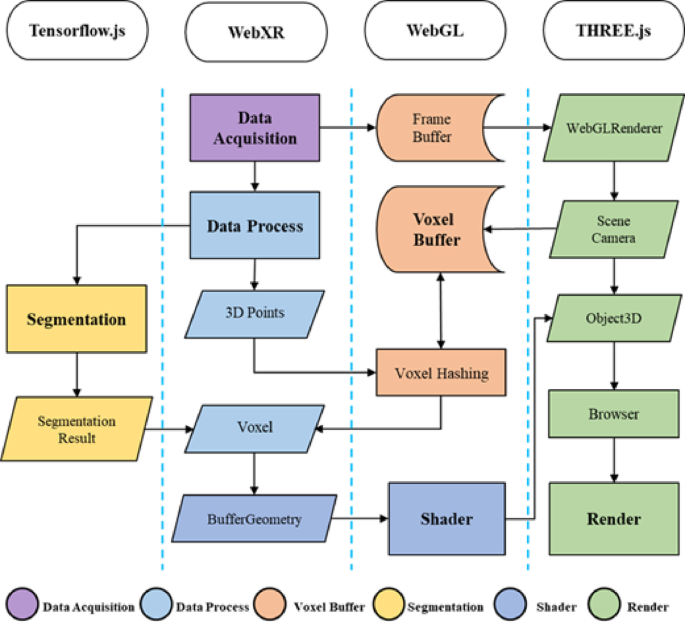
Researchers at National Chung Hsing University describe a mobile browser system, built on WebXR, Three.js and WebGL, that turns data from the WebXR Depth Sensing Module into point clouds and runs semantic segmentation on the device. Fusing results from several viewpoints improved accuracy in tests on a single Pixel 6 Pro running Chrome.
Original article at Scientific Reports -
Build and Stream Browser-Based XR Experiences with NVIDIA CloudXR.js
NVIDIA's CloudXR.js is a JavaScript SDK that streams GPU-rendered XR content from an OpenXR server to web browsers and headsets without an app store build. The post walks through creating a session and sending tracking data inside a WebXR render loop, and lists requirements including Meta Quest or Pico 4 Ultra headsets and Wi-Fi 6.
Original article at NVIDIA Technical Blog -
Meta's Immersive Web SDK reaches 1.0, and gaze-and-pinch comes to WebXR
Meta's Immersive Web SDK has reached version 1.0, adding gaze-and-pinch interaction for WebXR that plugs into its existing ray and grab systems. The framework pairs Three.js rendering with an entity component system and bundles locomotion, physics and scene understanding. Meta has not yet said which browsers or Horizon OS versions support the new input.
Original article at MIXED -
Meta’s New AI-Powered VR Toolkit Lets Anyone Build WebXR Experiences Without Coding
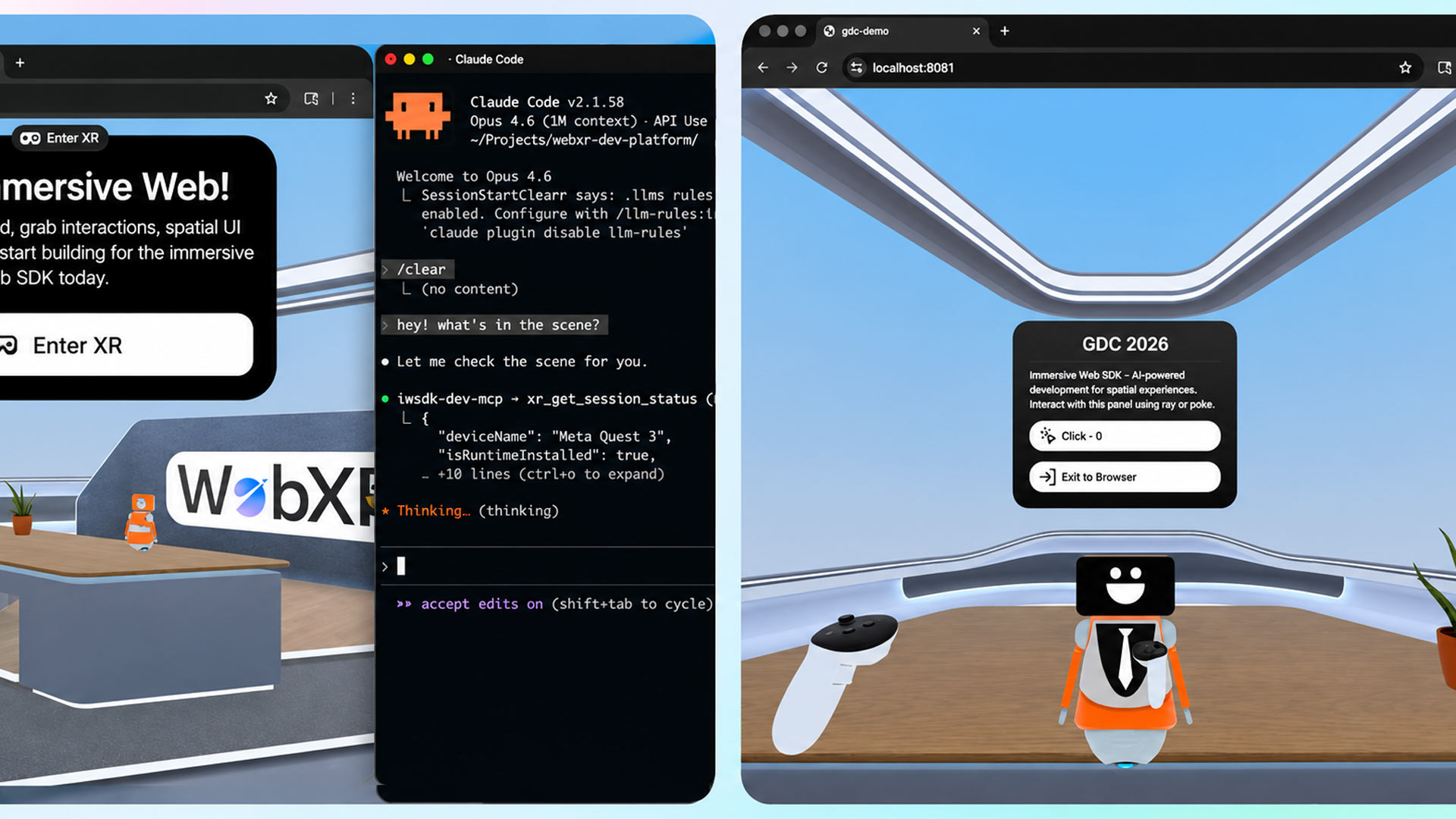
Meta has added an agentic workflow to its open-source Immersive Web SDK so AI coding assistants such as Claude Code, Cursor, GitHub Copilot and Codex can help build WebXR experiences. To show it off, Meta says it rebuilt its Project Flowerbed gardening demo in 15 hours using the new tools and existing art.
Original article at Road to VR -
SteamOS 0.5.7 Beta for Steam Frame brings WebXR, improved settings and more
Valve's SteamOS 0.5.7 beta for the Steam Frame headset turns on WebXR in Chromium 157 and later, opening browser-based immersive content on the device. The opt-in beta also updates SteamVR to 2.19.1, refines pose prediction, changes foveated sharpening and adds microphone noise suppression controls.
Original article at GamingOnLinux -
Google's XR Gemini Extension Lets You "Vibe Code" WebXR Experiences In Seconds
Google's XR Blocks Gem for the Gemini web app turns a text description into a mixed reality WebXR experience, generating HTML, CSS and JavaScript that can include hand interactions and physics. The author tested the results on Samsung Galaxy XR, Meta Quest 3 and Apple Vision Pro, and notes that output quality depends on the chosen model.
Original article at UploadVR -
Meta AI Agentic Workflow for WebXR development: how to get started and hands-on impressions
In a hands-on guide, the author sets up Meta's agentic workflow for the Immersive Web SDK, in which AI coding agents use MCP tools to drive a test browser and a virtual controller. He found grabbing and asset import worked well but physics and object placement struggled, and judges the workflow suited to small prototypes.
Original article at The Ghost Howls -
How Do VR Headsets Work? 12-Step Lab, 60 Min [2026]
A hands-on tutorial explains how VR headsets render a separate view per eye and then walks through a 12-step WebXR lab built with Three.js and Vite. Readers measure interpupillary distance, field of view, head pose and frame timing on a headset or emulator, with a reminder that WebXR requires HTTPS or localhost.
Original article at Shattered -
New immersive studio enhances global learning
Stanford Online has opened an immersive learning studio with a large LED wall, cinema-quality cameras and a green screen cyclorama for virtual production, along with AI-assisted workflows for faculty. The announcement mentions augmented and virtual reality only as future plans, and the studio itself is a video production facility.
Original article at Stanford Report -
XR Global Launches the World’s First Augmented Reality Online Casino Experience Across iOS, Android and the Immersive Web
In a press release, XR Global says it has launched augmented reality casino games, including slots, roulette and blackjack, that run on iOS, Android and the immersive web without special hardware. The company describes its cross-platform technology as patent pending and is pitching licences to online and social casino operators.
Original article at Business Wire